
Fire alarm installation for Nottingham businesses, what the law requires
Every non-domestic premises in England must have an 'appropriate' fire detection and warning system under the Regulatory Reform (Fire Safety) Order 2005. In practice that almost always means a BS 5839 Part 1 system specified by category (L1, L2, L3, L4, L5, M, P1 or P2) based on your fire risk assessment.
By Joshua Richardson & Benjamin Clurow · Co-Directors, JBRC Ltd · Last updated 18 March 2026
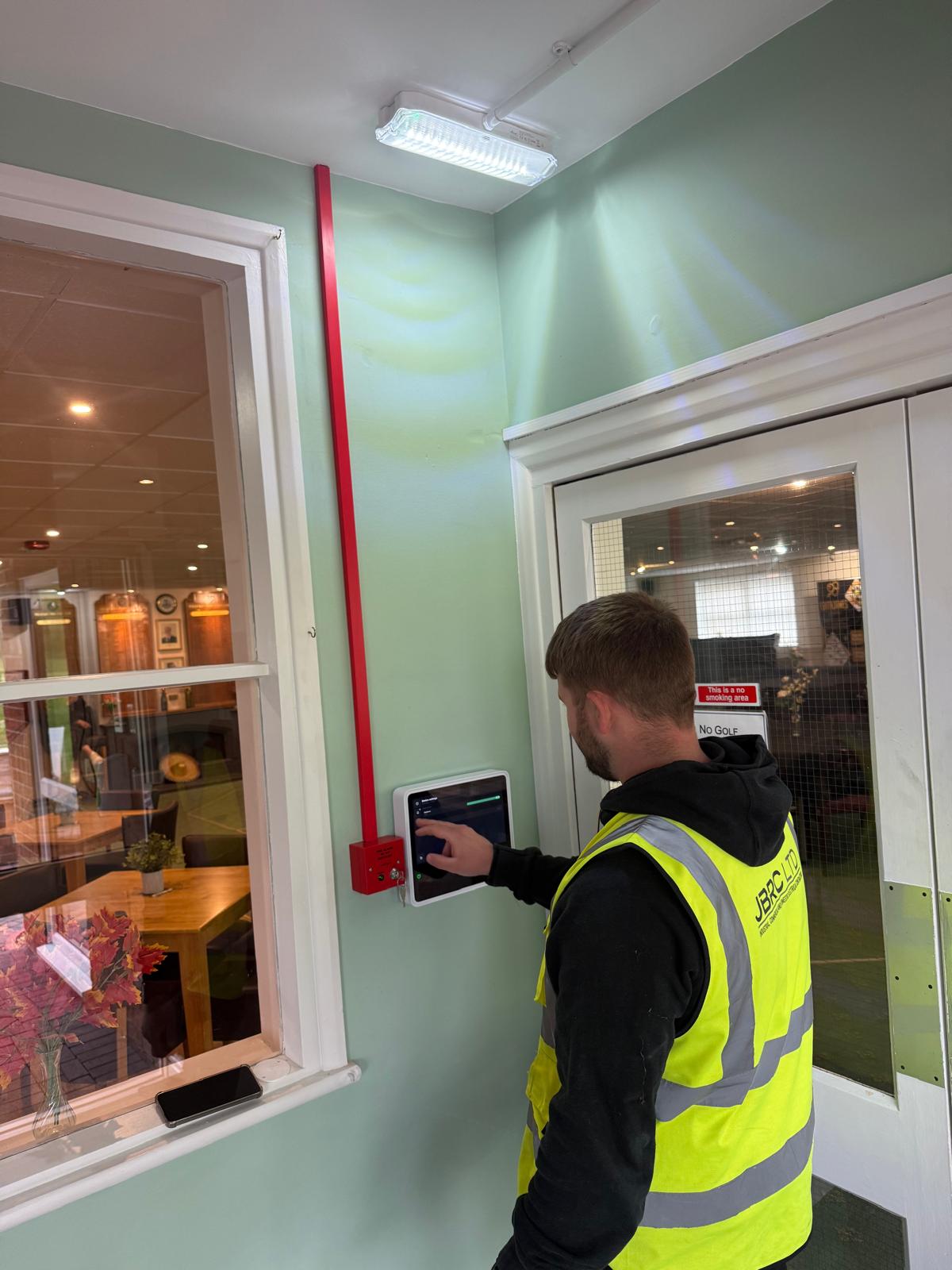
Yes, every Nottingham business needs a fire alarm system. The exact category (L1, L2, L3 etc.) is determined by your Fire Risk Assessment, not by the building size. Common defaults: L3 for offices and shops, L1 for HMOs and care homes, L4 for small low-risk premises, L5 for property protection. Self-installing or skipping the FRA is a criminal offence under the 2005 Fire Safety Order, fines are unlimited and 'responsible persons' can be imprisoned for serious breaches.
The legal framework
The Regulatory Reform (Fire Safety) Order 2005 places the duty on the 'responsible person', the employer, owner, occupier or person in control of the premises. The duty is to carry out and maintain a Fire Risk Assessment (FRA), and provide an 'appropriate' fire detection and warning system based on its findings.
BS 5839 Part 1:2017+A2:2023 is the code of practice for non-domestic systems. It defines the categories (below) and the design, install, commission and maintenance standards. Although BS 5839 isn't itself law, the Fire Risk Assessor and any visiting fire safety officer will reference it as the de-facto compliance standard.
The Fire Safety Act 2021 and Fire Safety (England) Regulations 2022 added duties for residential blocks of flats, including communal area detection and information for fire and rescue services. If you let or manage residential property in Nottingham above 11m, additional regulations apply.
BS 5839 categories explained
L1, Maximum life protection. Detection in every room and circulation space. Used for HMOs, care homes, hotels, hospitals.
L2, Life protection in escape routes plus rooms of high fire risk (kitchens, plant rooms, electrical rooms). Common for guest houses, small care premises.
L3, Life protection in escape routes and adjoining rooms (so you're warned before the corridor fills with smoke). The most common category for Nottingham offices and shops.
L4, Detection in escape routes only. Lowest life-protection category; suitable for small, low-risk premises with simple layouts.
L5, Bespoke localised protection for specific risks (e.g. a server room or workshop area).
M, Manual call points only, no automatic detection. Permitted only where the FRA confirms manual operation provides adequate warning (rare today).
P1 / P2, Property protection categories rather than life protection. Often required by insurers.
Which category does my premises actually need?
Indicative defaults based on the Nottingham premises we install for. Your FRA always supersedes a generic default.
| Premises type | Typical category | Notes |
|---|---|---|
| Small office (<10 staff) | L3 or L4 | L4 if simple single-storey, L3 if multi-storey |
| Retail shop | L3 (+ M call points) | Higher footfall = more detection |
| Restaurant / bar | L2 or L3 | L2 for kitchens; sounders to BS 5839 audibility |
| Warehouse | L4 or P1 | P1 if high-value stock |
| HMO / hotel | L1 or L2 | L1 for sleeping risk + multiple occupants |
| Care home | L1 | Always L1, sleeping vulnerable persons |
| Industrial unit | L3 + P1 | Insurer often dictates property cover |
Maintenance, false-alarm reduction and insurer requirements
BS 5839 requires the system to be tested weekly by a competent person on site (usually 30 seconds at one call point per week) and serviced every 6 months by a qualified contractor. We service over 200 commercial systems across Nottinghamshire on rolling 6-monthly contracts, typical annual cost £180–£420 depending on detector count.
False alarms cost UK businesses around £1bn a year and are a leading reason Nottinghamshire Fire & Rescue charges for repeat callouts. BS 5839 requires false alarms to be investigated and the rate driven below 1 per 100 detectors per year. We design with multi-criteria detectors (heat + smoke + CO) and zoned investigation delays to minimise false alarms.
Insurers increasingly stipulate the category and require remote monitoring for premises holding £500k+ stock or critical equipment. We integrate with all major UK ARC providers, Custodian, EMCS, Banham, at install.
For the full service overview, see our Commercial fire alarm systems in Nottingham page, or browse all commercial electrical services.
Joshua Richardson & Benjamin Clurow
Co-Directors, JBRC Ltd · 30+ combined years (per Checkatrade)
Joshua Richardson and Benjamin Clurow are the joint co-founders and named directors of JBRC Ltd, a Nottingham-based electrical contractor (Companies House #17015285). The business is NICEIC Approved and a NICEIC Part-P Domestic Installer, working across Nottingham, Derbyshire and Leicestershire on domestic rewires, EICRs, EV charger installs, commercial fit-outs and three-phase work.
- NICEIC Approved Contractor
- NICEIC Part-P Domestic Installer
- Co-Directors, JBRC Ltd (Companies House #17015285)
Common questions on this topic
Related guides
Need a BS 5839 fire alarm system designed and installed?
Send us your Fire Risk Assessment and a floor plan. We'll come back within 48 hours with a category-matched design, fixed price, and 6-monthly service contract.
Or read the full Commercial fire alarm systems in Nottingham service page.