
7-bed HMO, Beeston, full Grade A LD2 install over a weekend.
Council licence inspection cleared on first visit. Service contract in place.
Beeston, Nottingham
Category L1 to L5 fire detection and alarm systems for Nottingham offices, retail, HMOs and industrial units, sized to your fire risk assessment, your insurer, and your premises, with commissioning paperwork insurers, councils and the fire service accept first time.
BS 5839-1 / -6 certified · Design, install & commissioning · Insurer-ready certification
A commercial fire alarm system is the network of detectors, sounders, manual call points and a central control panel that warns occupants of a fire in time to evacuate. Under BS 5839 there are two parallel standards: BS 5839-1 for non-domestic premises (offices, shops, schools, factories, care premises) and BS 5839-6 for residential settings including HMOs, blocks of flats and supported living.
Both require a system that is designed (not just bought from a wholesaler), installed by competent persons, commissioned by a third party, commissioned by us, and logged in a fire log book held on site. We deliver all five, design, install, commission and log book, for premises across Nottingham and the East Midlands.
Our typical clients are landlords with newly-licensed HMOs, retail and hospitality tenants on category fit-outs, office occupiers post-office-move, and industrial sites where insurer requirements have escalated after a near-miss elsewhere in the trade. Where a Fire Risk Assessment exists we work to it directly; where one doesn't, we'll specify a category from observed risk and document it.
We see fire alarm systems fail compliance for the same reasons every quarter. No category statement (so the FRA can't be reconciled to the system). Mixed-manufacturer detectors and panels without compatibility certification (you cannot legally connect a different brand's heads to most panels). Sounders below 65dB at the bed-head in residential settings. No commissioning certificate from a third party. And no documented record of the design category against the Fire Risk Assessment.
Each of these voids your fire safety compliance and most likely your insurance. After a fire, the loss adjuster checks the logbook before they check the loss. A system without a current commissioning certificate gets the claim rejected. We've been called in by buyers and underwriters more than once to certify the system before they will sign off the deal.
The fix is design, install and commission, done by a competent contractor against BS 5839 from day one. It is not the place to save money.
Category statement (L1 / L2 / L3 / L4 / L5 or P-grade for residential), zone plan, detector schedule, sounder calculations.
Fire-rated cable (Firetuf FP200 or equivalent) clipped, capped or in conduit per the design. Out-of-hours where required.
Panel mounted, addressable loops connected, devices installed and labelled per the zone plan.
Every device tested, sounder sound levels measured, cause-and-effect logic confirmed, third-party commissioning certificate issued.
Logbook handed over and explained to the responsible person, with all design and commissioning paperwork in a single pack for the file.
Design, install and commission against the relevant standard for non-domestic and residential premises.
Commissioning certificates and logbook accepted by every commercial insurer we've dealt with, no resubmission, no resurvey.
Design, first-fix, install and commissioning by the same team, one point of contact, one set of paperwork.
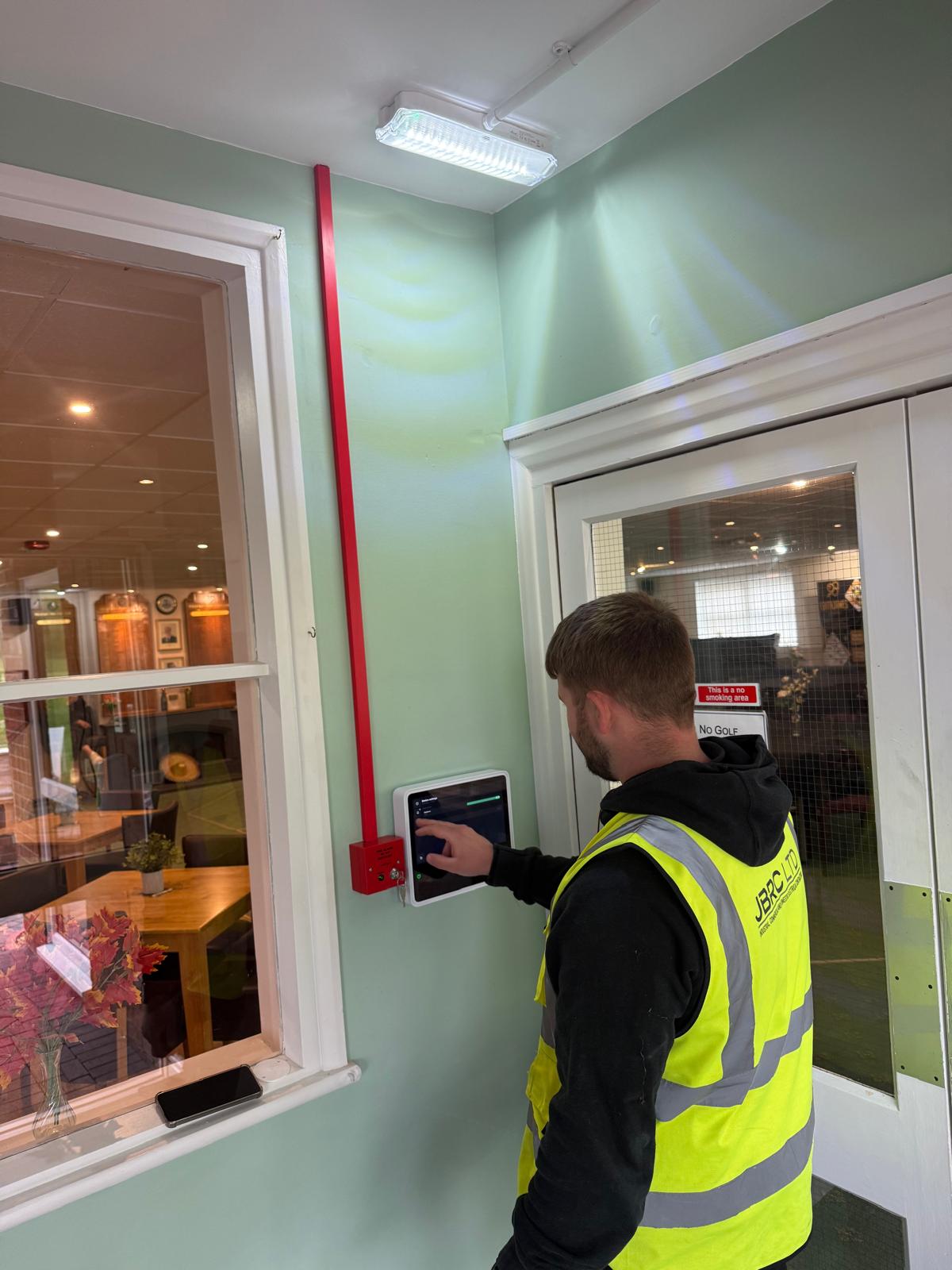
Ajax fire detection system commissioned at a 7-bed licensed HMO in Beeston, Grade A, LD2.
BS 5839-1 categories run from L1 (life protection, automatic detection in every room of a non-domestic property) through L2 (life protection in escape routes plus high-risk rooms) and L3 (life protection in escape routes only, the most common office spec) down to L4 (escape routes only with manual call points) and L5 (a designed system for a specific risk, e.g. a server room). The category drives detector count, position and cost. Most Nottingham offices and retail units run L2 or L3.
BS 5839-6 covers residential premises and uses Grade A through F instead. Licensed HMOs of three storeys or more typically need Grade A LD2 (a full fire alarm system with mains-powered detectors and battery backup, panel-controlled), equivalent in build cost to a small commercial L3. Smaller HMOs can run on Grade D1 mains-interlinked detectors without a panel. The right grade comes from the FRA, not from price.
Addressable systems use a single loop of cable that returns to the panel, with each detector having a unique address, which means the panel tells you exactly which device is in alarm or fault. Conventional systems use multiple zone cables and tell you only the zone, not the specific device. We install addressable as default for any property over 5 zones because fault diagnosis is dramatically faster and the system is far easier to extend later. We predominantly install Ajax fire detection systems where they suit the brief.
Fire alarm pricing scales with category, device count and premises type. Real ranges from the last 12 months, quoted by site survey, never over the phone.
| Scope | Typical price (incl. VAT) | Notes |
|---|---|---|
| Small office / retail Cat L3 (under 200m²) | £1,800 – £3,200 | Conventional or addressable, 8–14 devices, 1–2 zones. |
| HMO Grade A LD2 (4–7 bedrooms) | £2,400 – £4,800 | Most-fitted residential spec, addressable, panel + 12–22 devices. |
| Mid-size commercial Cat L2/L3 (200–800m²) | £3,500 – £8,500 | Addressable, 2–5 zones, integrations with door release or smoke control. |
| Large or industrial Cat L1/L2 | £8,500 – £25,000+ | Multi-loop, multi-zone, networked panels, repeater displays. |
Fire alarm work runs across our full coverage area, Nottingham city, Mansfield's industrial belt, HMO portfolios in Lenton and Beeston, hospitality across West Bridgford, and licensed properties in Loughborough.
Co-Directors
NICEIC Approved Contractor, NICEIC Part-P Domestic Installer
Joshua Richardson and Benjamin Clurow co-founded JBRC Ltd and are the two named directors at Companies House (#17015285). They jointly run the business, both surveying, designing, installing and commissioning BS 5839 fire alarm systems across Nottingham, so every customer is dealing directly with a director from quote through to certification.
7-bed HMO, Beeston, full Grade A LD2 install over a weekend.
Council licence inspection cleared on first visit. Service contract in place.
Beeston, Nottingham
Lace Market office tenant, Cat L3 retrofit during a 2-week fit-out.
Commissioned out-of-hours so the office never closed. Insurer accepted certificate same day.
Lace Market, Nottingham
Mansfield warehouse, Cat L2 with smoke control integration.
Networked panel with repeater at gatehouse. Scope creep absorbed without re-quote.
Mansfield
Last updated 22 April 2026
Insurer-ready paperwork. Designed, installed and certified by a single contractor.