
Signs your Nottingham home needs rewiring
If your home has black bakelite switches, round-pin sockets, fabric-covered cables, no RCDs in the consumer unit, or wiring you know was fitted before 1970, it almost certainly needs a full rewire. An EICR is the way to confirm, but ten common warning signs flag it long before the test.
By Joshua Richardson & Benjamin Clurow · Co-Directors, JBRC Ltd · Last updated 5 April 2026
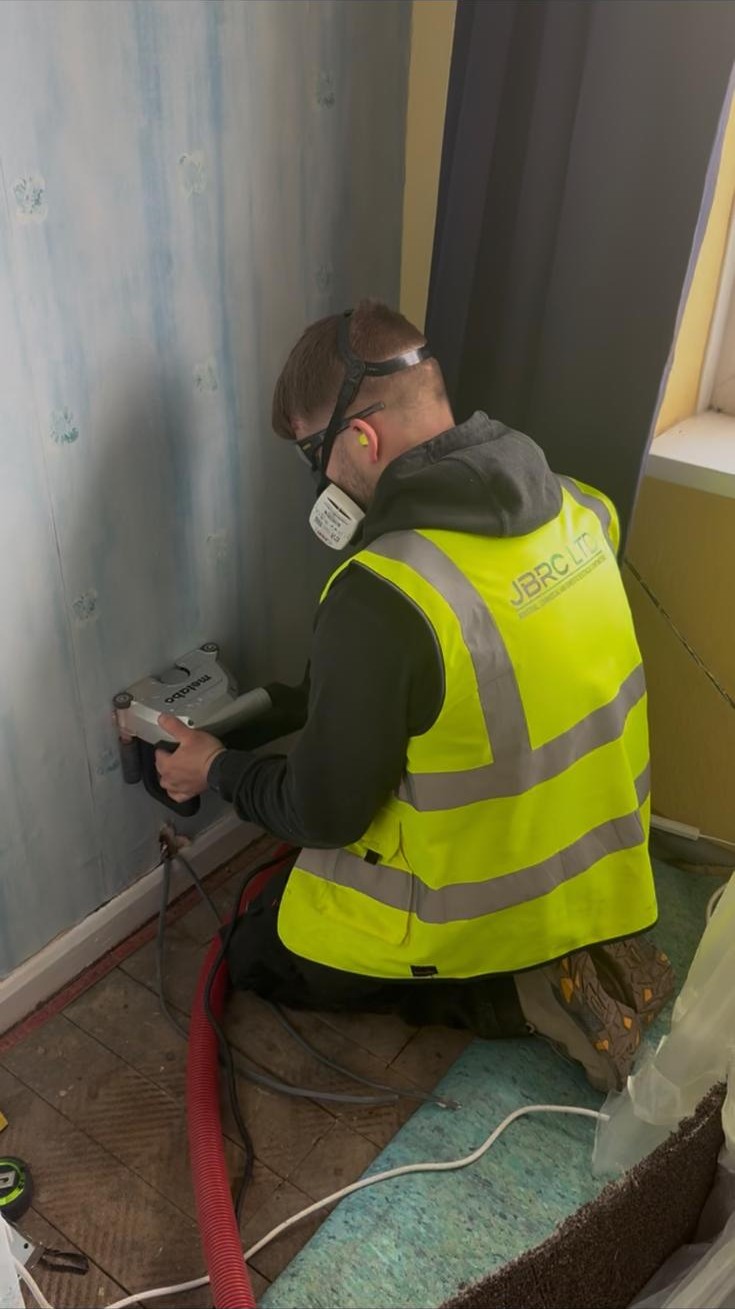
The clearest signs: rubber or fabric-covered cables (pre-1965), no RCD protection on socket circuits (pre-2008), black bakelite or round-pin sockets (pre-1960), consumer unit with rewireable fuses rather than MCBs, frequent unexplained RCD trips, scorch marks around sockets, lights dimming when high-load appliances start, and any electrical work you can see that's been done in twin-and-earth from the loft into rubber from the wall. Any one of these is a red flag; two or more means a rewire is overdue.
If your home was last rewired before 1985 it's also nearing end of life regardless of visible signs, PVC insulation generally lasts 50 years before becoming brittle.
The visible warning signs
Rubber-insulated or fabric-braided cables. Used until around 1965, the rubber dries, cracks and crumbles. You can sometimes see this in the loft or under floorboards. Once exposed it's a fire risk.
Round-pin sockets, black bakelite switches, brown bakelite light switches with porcelain back-boxes. All pre-1960 indicators. Even if they still work they're not earthed, not RCD-protected and almost certainly fed from non-compliant cabling.
A consumer unit with rewireable fuses (the cylindrical porcelain holders) or cartridge fuses, rather than miniature circuit breakers (MCBs) and an RCD. Pre-1990s wiring almost always means pre-current-regs everything.
Scorch marks, browning or melting around sockets and switches. Indicates loose terminals heating up under load, usually only fixable by re-terminating the circuit, but sometimes by replacing it entirely.
The behavioural warning signs
Frequent RCD trips with no obvious cause. A healthy installation rarely trips. Frequent trips usually mean cumulative insulation breakdown across one or more circuits, often impossible to repair without rewiring the affected runs.
Lights dimming or flickering when the kettle, microwave or shower starts. Indicates inadequate cable cross-section or loose terminations on the lighting circuit's neutral. If it happens on multiple circuits the issue is probably the meter tails or the main earthing.
A faint smell of warm plastic from sockets or the consumer unit, even briefly. Always investigate, it's the single most reliable predictor of a future fault.
Switches and sockets warm to touch under normal load. Should be ambient temperature. Warmth means resistive heating in the connections.
The structural warning signs
No earth bonding to gas pipe or water main. Required since the early 1980s. Lift the floorboard above the rising main, if there's no green-and-yellow conductor clamped to the pipe, you're due an upgrade.
Cables emerging from walls in colours that don't match (red/black/yellow alongside brown/blue/grey). Indicates piecemeal additions over decades. Even if each addition was compliant at the time, the overall installation rarely passes a current EICR.
Lighting circuits with no earth conductor (still legal in some configurations until the late 1960s but never compliant for modern metal-clad fittings). The first metal pendant or chrome downlight someone fits will fail an EICR.
What to do if you've spotted multiple signs
Book an EICR. £140–£190 for a typical home, and the report tells you exactly which circuits need replacement, which need remediation and which are fine. We'd always rather sell you a £180 EICR than a £6,000 rewire you didn't need.
Don't rely on a quick visual inspection by a contractor on a sales call, without insulation resistance testing and earth fault loop measurement, no one can honestly tell you whether your wiring needs replacing. We've seen homes with 1960s cabling that test perfectly and 1995 homes with serious latent faults.
If you're buying a Nottingham property and the seller can't produce a recent EICR, build the cost of one into your offer. £180 to know whether you're inheriting a £6,000 problem is the cheapest insurance in conveyancing.
For the full service overview, see our Domestic rewire in Nottingham page, or browse all domestic electrical services.
Joshua Richardson & Benjamin Clurow
Co-Directors, JBRC Ltd · 30+ combined years (per Checkatrade)
Joshua Richardson and Benjamin Clurow are the joint co-founders and named directors of JBRC Ltd, a Nottingham-based electrical contractor (Companies House #17015285). The business is NICEIC Approved and a NICEIC Part-P Domestic Installer, working across Nottingham, Derbyshire and Leicestershire on domestic rewires, EICRs, EV charger installs, commercial fit-outs and three-phase work.
- NICEIC Approved Contractor
- NICEIC Part-P Domestic Installer
- Co-Directors, JBRC Ltd (Companies House #17015285)
Common questions on this topic
Related guides
Local coverage
Worried about your wiring? Book a £180 EICR first.
We'll test every circuit, photograph the consumer unit, and email a clear report telling you whether you need a rewire, remedial work, or nothing at all.
Or read the full Domestic rewire in Nottingham service page.